White-label shop or freelancer: which one won't ghost you?
Shops and freelancers both go quiet, just in different ways. Here is how each one ghosts, and the five rules that make a silence cheap whichever you hire.
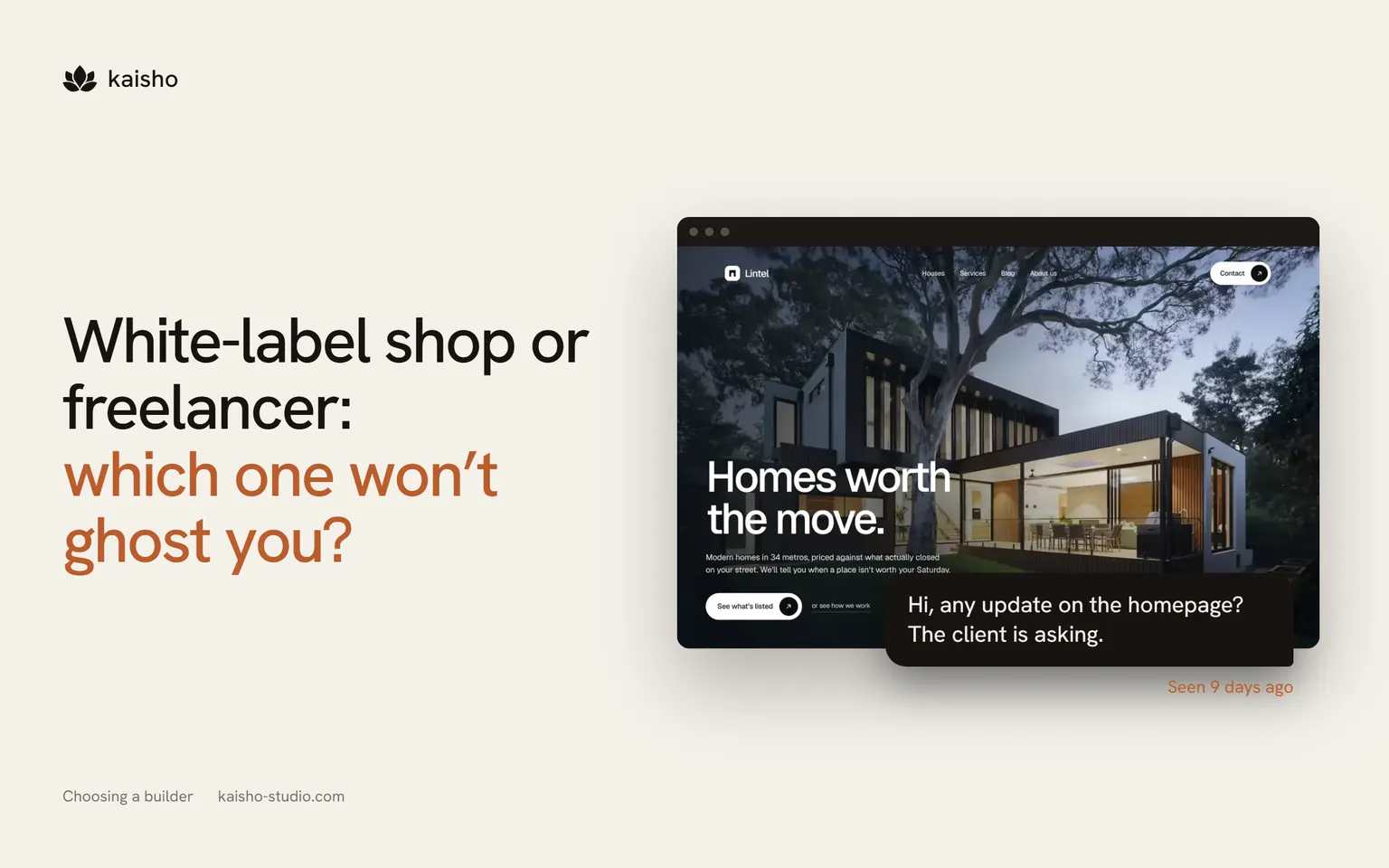
Day one, the developer replies in ten minutes. Day nine, nothing. You check your spam folder. You check their LinkedIn. You draft a message to your client that says "small delay" and you do not send it, because you do not know how small. That silence is the real question behind every white-label agency vs freelancer debate. Not price. Not portfolio. Who goes quiet on you, and what does it cost you when they do?
Agency owners usually frame this as a choice between two risks. A white-label shop feels safer because it is a company. A freelancer feels better because you talk to the person who builds. Both feelings are partly right. Both miss the thing that actually protects you. I build white-label sites for agencies on my own, so I have an obvious side in this. I will try to be fair to the other one anyway.
Why ghosting is the fear that matters
A website is rarely the part of the package an agency makes its money on. It is the part everything else waits for. The SEO retainer needs pages to optimise. The ads need a landing page. The social plan needs somewhere to send people. When the builder goes quiet, all of that waits with them, and so does the money attached to it.
And you are the face of it. White-label means your client has never heard of your developer. So when the staging link does not arrive, it is your name on the late project and your voice on the awkward call. You can fix an ugly design in one round of feedback. You cannot fix a builder you cannot reach.
So the useful question is not "who is better?" It is "who is less likely to disappear, and what happens to me if they do?"
White-label agency vs freelancer: how each one goes quiet
Here is the part most comparisons skip. Shops and freelancers both ghost. They just do it in different ways.
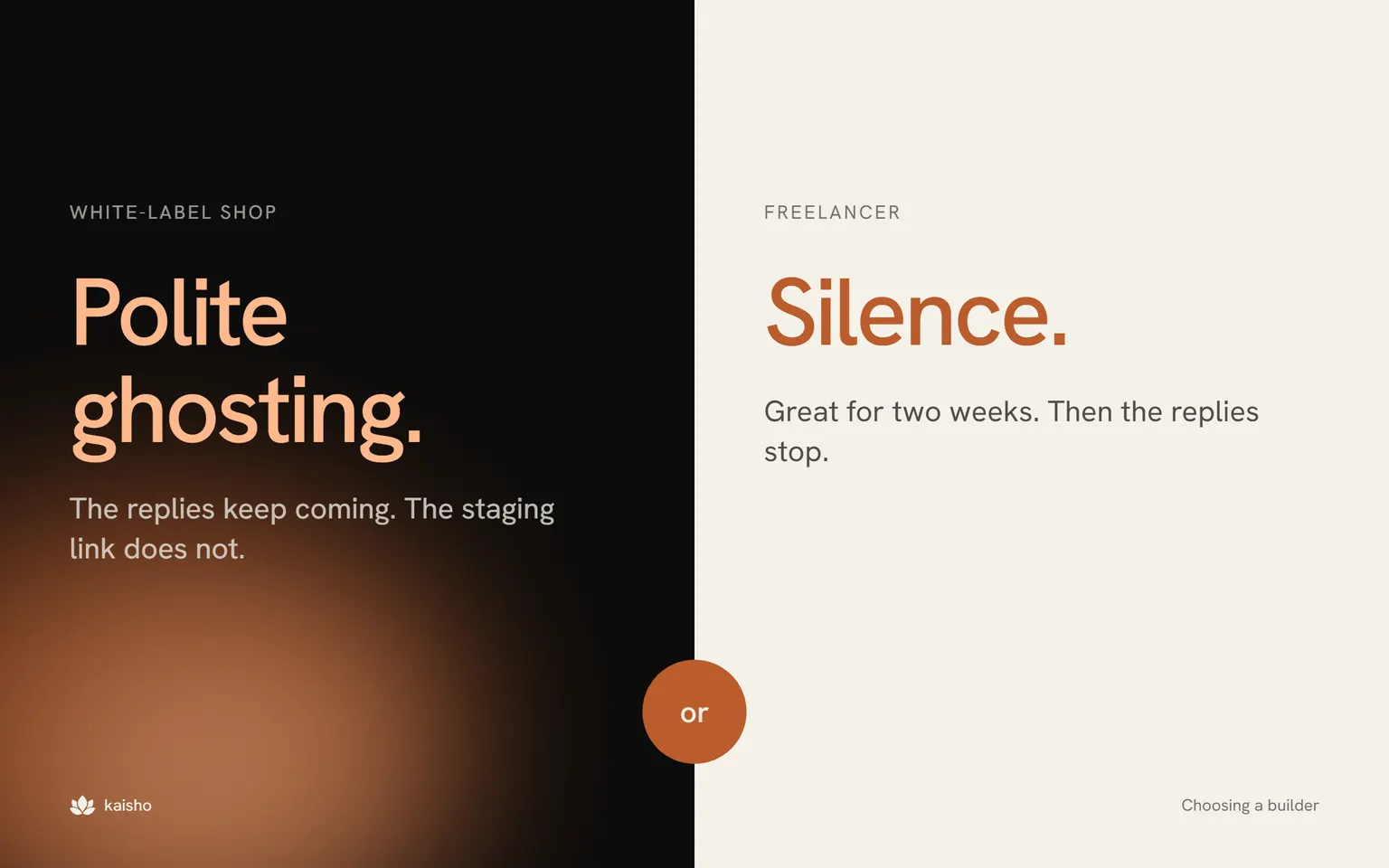
How a white-label shop goes quiet
A shop almost never stops answering. An account manager replies quickly and politely. What stops is the work. Your project sits in a queue behind bigger clients, and the people who build it change from week to week. The replies keep coming. The staging link does not.
Call it polite ghosting. It is harder to spot than silence, because every email sounds fine. You only notice when you add up the weeks. And when you push, you are pushing on someone who does not build anything. The person you talk to is not the person doing the work.
What a shop does well: capacity. If you have ten similar sites a month, a team can absorb that. If someone gets sick, someone else picks it up, in theory.
How a freelancer goes quiet
A freelancer's version is the one every agency owner has a story about. They are great for two weeks. Then a bigger client turns up, or life does, and the replies stop. One person means one point of failure. There is no account manager to chase and no one else who knows the project.
What a freelancer does well: you talk to the builder. Feedback does not pass through three people. Decisions take minutes, not tickets. And a good one cares about your project because it is one of a few, not one of fifty.
So the honest answer to "white-label agency vs freelancer" is that each risk is real. A shop can bury you. A freelancer can vanish. Picking a type of company does not pick a behaviour.
The reframe: make silence cheap

You cannot vet someone's future. You do not know who will win a bigger contract next month or get the flu in week three. What you can control is how much a silence costs you.
If your builder disappears and you have a working staging link, the logins in your own accounts and only paid for what you have seen working, a silence is annoying. You can hand the project to someone else on Monday. If your builder disappears and you have screenshots, their hosting and an invoice paid upfront, the same silence is a crisis.
That is the shift. Stop asking "will they ghost me?" and start asking "if they did, what would I lose?" The right setup turns the worst case from a disaster into an inconvenience. And builders who agree to that setup tend to be the ones who do not need it.
How do you ghost-proof a white-label build?
These five rules work whether you hire a shop or a freelancer. They are also the fastest way to tell which kind of either you are dealing with.
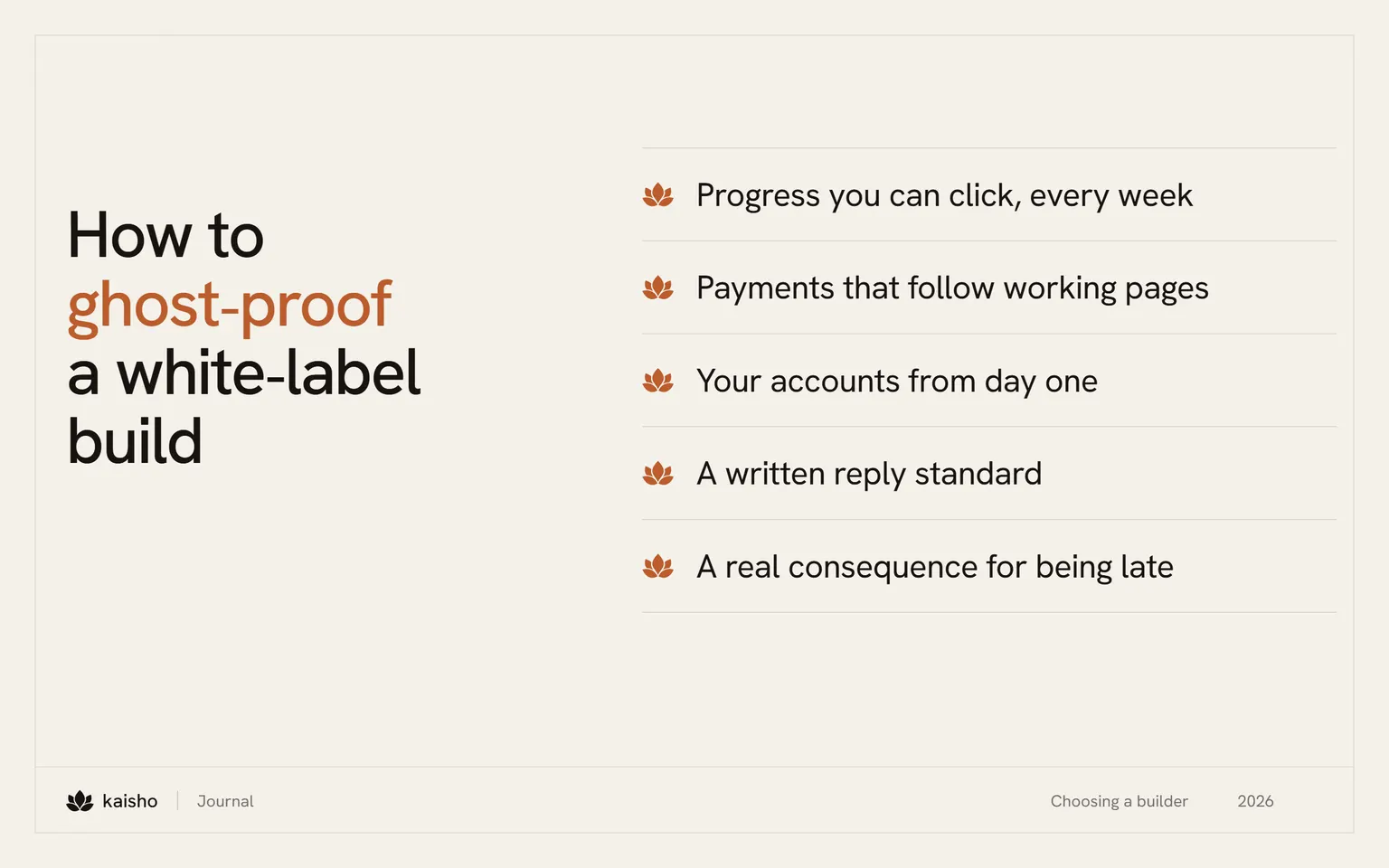
1. Progress you can click, every week
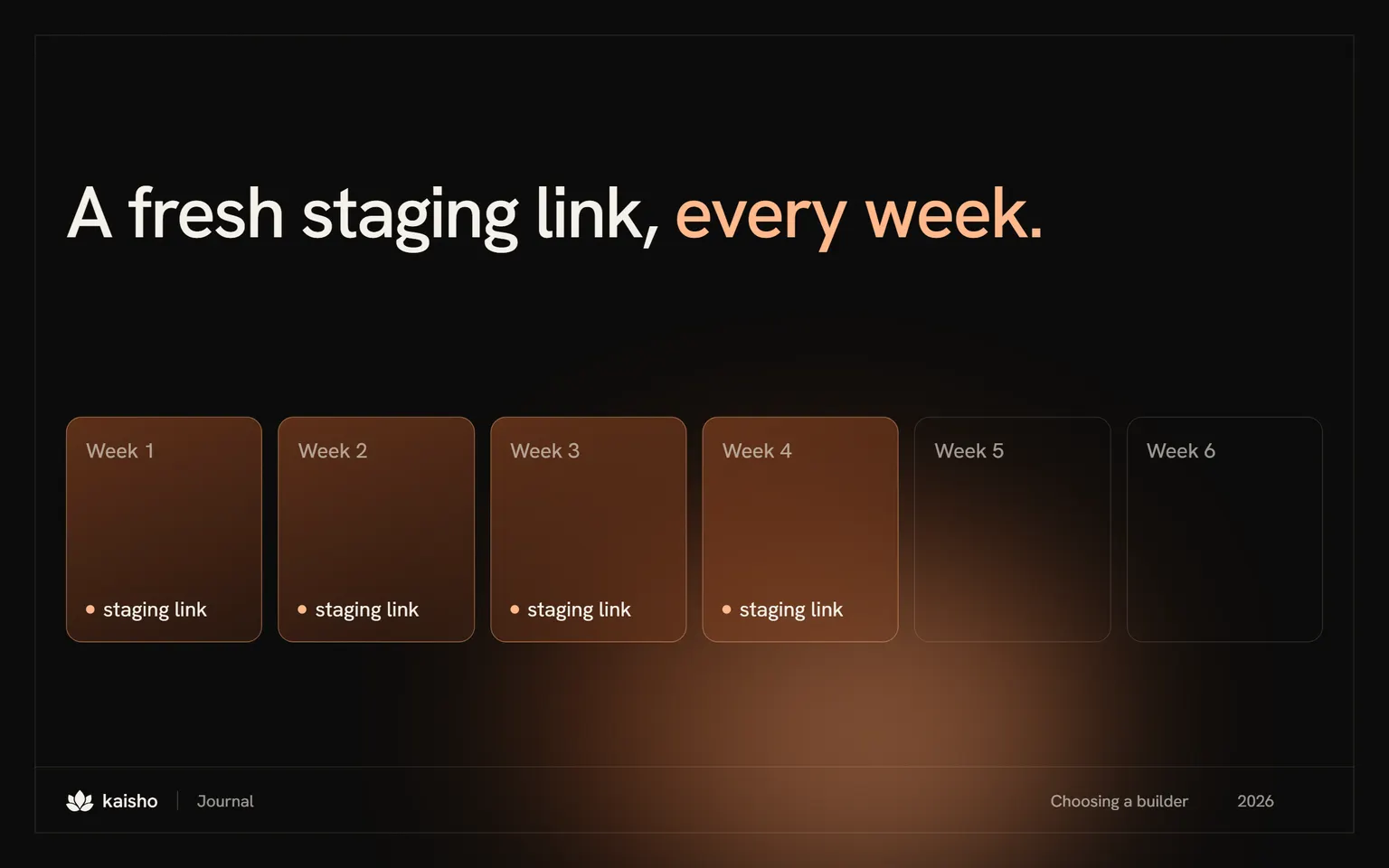
Ask for a staging link early and a fresh one every week. Not a status update. Not a screenshot. A link you can open on your phone. A weekly link is the simplest early warning there is: if it does not arrive, you know in days, not at the deadline. Shops that resist this are hiding a queue. Freelancers who resist it are hiding a schedule.
2. Payments that follow working pages
If most of the money moves before you see anything work, you carry all the risk. A fairer shape is a deposit to start, the next payment at a working staging link and the last at launch. Then every payment buys something you can click, and a disappearing builder walks away with a deposit, not your budget.
3. Your accounts from day one
Hosting, domain, CMS, Framer or Webflow workspace: all in your name, from the start. Plus a short document explaining how the site is built. This is what makes a silence survivable. Whoever holds the logins holds you, so make sure it is you.
4. A written reply standard
Agree how fast they answer during the project. One working day is reasonable for a small agency's builder. It sounds minor. It is the rule that turns "they have gone quiet" from a feeling into a fact you can act on, because you know exactly when a reply is late.
5. A real consequence for being late
Ask what happens if the first working link is late. "That won't happen" is not an answer. Money back, or your right to walk away without paying more, is. Someone who has thought about the consequence has thought about the deadline.
For the full list of questions to send before you sign, see how to vet a white-label web developer before you sell the site.
So which should a small agency choose?
With those five rules in place, the choice gets simpler, because you are choosing for fit instead of for fear.
A white-label shop fits when you have steady volume of similar sites, a clear process of your own and the patience to manage a queue. You trade direct contact for capacity. Push hard on the weekly staging link, because that is where a queue shows itself.
A freelancer fits when your projects vary, your clients care about the details and you want decisions made in one conversation. You trade capacity for a senior person who knows your project. Push hard on ownership and documentation, because that is what covers the single point of failure.
Whichever you pick, start with one small, real project before you hand over your biggest client. A campaign landing page. A rebuild of a tired WordPress site. Your own agency website, the one you keep meaning to fix. You learn more from one delivered project than from any number of calls.
What this looks like when I build for an agency
I am a freelancer, so the ghosting fear is about people like me. I would rather answer it with terms than with promises.
It started before I worked with agencies. When I pitched for a law-directory project, I did not send a deck. I built a working demo, put it on a live link and sent it with the proposal. On the call, the client said it was smart. It was not clever. It was proof before anyone had committed to anything.
That is still the deal. A working staging link within 3 working days of an agreed design direction, or your deposit back. If I am late, you choose: I finish the site, or we part ways. The clock starts when you confirm the design direction by email, and that email states the actual date the staging link is due. Payments run 30% to start, 40% at the working staging link and 30% at launch. The site, logins and files live in your accounts from day one, fully documented. You get a fresh staging link every week and a reply from me within one working day. No footer credit, and no contact with your client unless you invite it.
That is the five rules above, written as terms. If I ever went quiet, you would lose a deposit and keep a working site in your own account.
Your next step
Before you sell the next website, take the five rules to whoever builds for you now. Ask for this week's staging link. Ask whose account the hosting is in. Ask what happens if the first link is late. Then notice how long the reply takes.
Shop or freelancer, the one worth keeping is the one who makes those questions boring to answer. Your name is on the site. Make sure the deadline behind it belongs to someone you can see.
Frequently Asked Questions
Is a white-label agency safer than a freelancer?
Not by default. A shop rarely stops replying, but your project can sit in a queue while the emails stay polite. A freelancer gives you direct contact but is a single point of failure. In any white-label agency vs freelancer choice, the safer option is whoever agrees to weekly staging links, staged payments and your ownership of every account.
What should I do if my white-label developer stops replying?
First check what you hold: the staging link, the logins and what you have paid for. If the site lives in your accounts and is documented, you can bring in another builder quickly. Set that up before the project starts, because it is very hard to arrange after someone has gone quiet.
How do I know if a white-label shop has put my project in a queue?
Ask for a working staging link every week. Replies can sound fine for weeks while nothing moves, but a link either exists or it does not. If the link keeps slipping while the updates stay cheerful, your project is waiting behind someone else's.
Do white-label freelancers cost less than agencies?
Often, because there is no account management layer to pay for, but price depends on scope more than on company size. Compare fixed prices for the same written scope rather than hourly rates. Whichever you choose, tie payments to working pages so a low price never comes with high risk.
What is the best way to test a new white-label partner?
Give them one small, real project with a short timeline, such as a campaign landing page. It shows how they handle dates, feedback and replies under real conditions. That tells you more about a white-label agency vs freelancer decision than any sales call.
