How to vet a white-label web developer before you sell the site
A portfolio shows what a builder finished. It does not show what happens in week three. Seven checks to vet a white-label web developer before you sell the site.

Your client asks how the website is coming along. You say it is nearly there. Then you open your inbox to check, because you do not actually know. Your developer went quiet on Thursday. That gap, between what you told your client and what you can see, is the whole reason to vet a white-label web developer properly before you sell the site. Not after the first deadline slips.
Most vetting checks the wrong things: a portfolio, a price, one friendly call. None of that tells you what happens in week three, when the builder has two other clients and yours is the smallest. This guide covers the checks that do. It is written by a builder, so treat it as the inside view: these are the checks I would want any agency to run on me.
Why does a late website hurt an agency more than a bad one?
For most agencies, the website is not the product you really sell. It is the doorway to the retainer. SEO cannot start without pages. Ads cannot run without a landing page. Social has nothing to point at. So when the site is late, your income slips with it, and next month's campaign stalls before it starts.
And the person apologising is you. Your client does not know your developer exists. That is the deal with white-label work, and it is a good deal until something goes wrong. Then the missed deadline, the excuse and the damage control are all yours.
That is why the fear is so specific. It is rarely "the site might be ugly." Design can be fixed in a round of feedback. The real fear is the builder disappearing mid-project: the unanswered email, the staging link that never arrives, the logins that live in someone else's account. It is also the thing most vetting never tests.
What agencies usually try, and why it keeps going wrong
There are four common routes. Each can work, and each fails in a predictable way.
Offshore white-label shops
Cheap, with capacity. But you brief an account manager, who briefs a team you never meet, and quality depends on who picks up the ticket that week. The person who sells to you is not the person who builds for you.
Solo freelancers
A good one gives you a senior person and direct contact. The risk is the one every agency owner names first: ghosting. One person means one point of failure.
Hiring in-house
It solves control, then charges you for it. Website work at a small agency is uneven, so you pay a salary through the quiet months or check a junior's work yourself.
Templates and no-code platforms
A shortcut until the platform raises its prices or the template fights every change your client asks for. The margin you saved leaks out in the hours you spend bending it into shape.
All four ask you to trust before you can see. You find out the truth at the deadline, the most expensive moment to find out anything.
The reframe: stop vetting promises, start vetting proof

When you vet a white-label web developer, you are not really judging talent. Plenty of people can build a decent site. You are judging whether this person will deliver what they promised, on the date they promised, without you chasing them. That is a behaviour, and behaviour only shows up under real conditions.
So the question changes from "are they good?" to "what can I see, and when?" A builder worth hiring makes that easy. They show you working things early, tie your payments to those things and keep everything in your accounts. A builder who resists any of that is telling you something before you have spent a cent.
I call this being built to be replaceable. The best partner is one you could fire tomorrow and lose nothing.
How do you vet a white-label web developer? Seven checks before you sell the site
Run these in order. The first five cost you a few emails. The last two are settled in writing before any work starts.
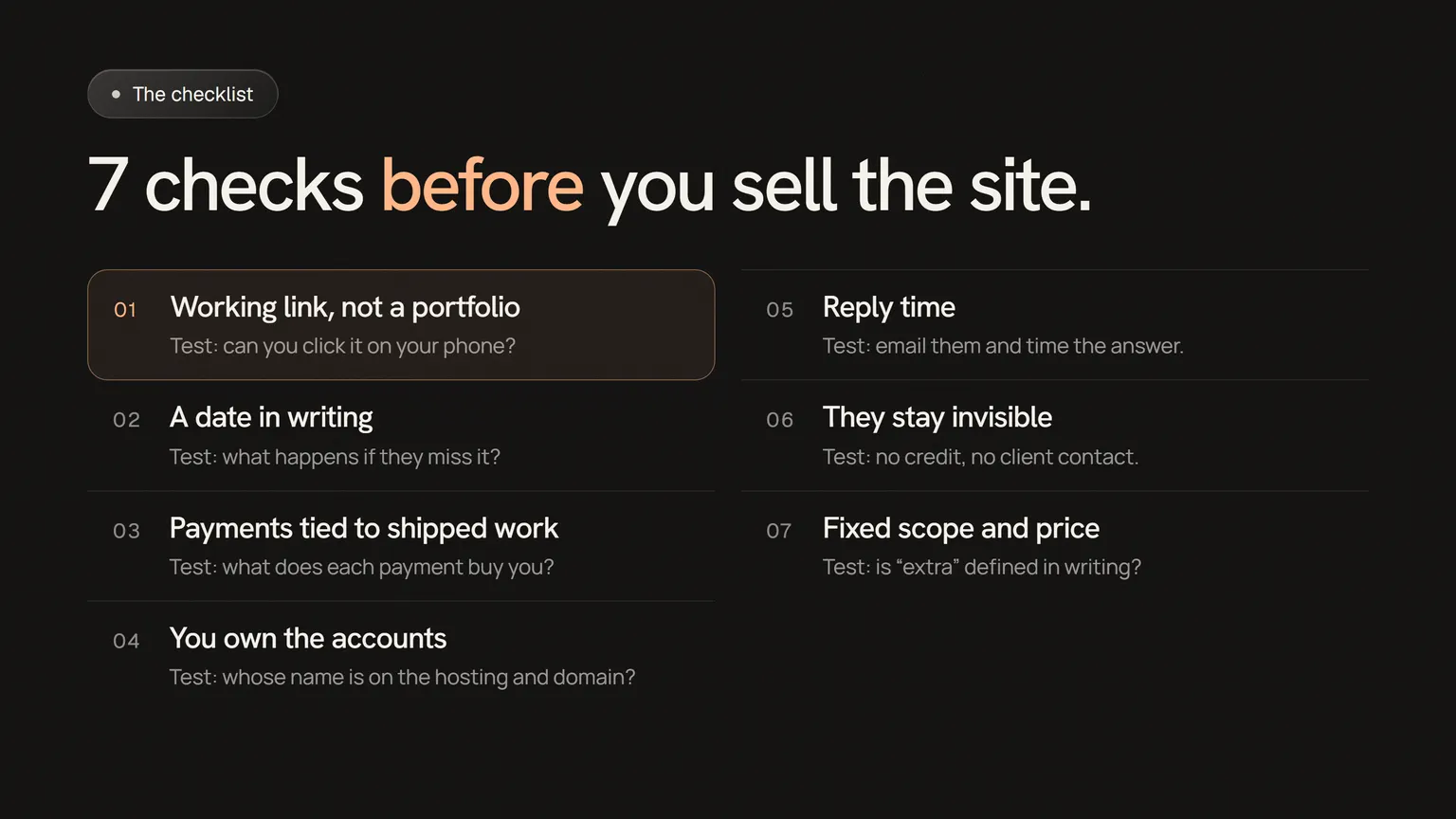
1. Ask for a working link, not a portfolio
A portfolio shows what someone finished, with unlimited time and possibly with help. A working link shows what they build now. Ask for a live staging site from current work, or a small piece of yours. Then click everything. Does it work on your phone? Do the forms send? A builder who only sends screenshots has given you a picture of a website, not a website.
2. Get a date in writing, and ask what happens if they miss it
"Two to three weeks" is not a date. Ask when the first working staging link will exist, counted from a clear starting point such as the day you agree the design direction. Then ask the question most agencies skip: "What happens if you are late?" A real consequence, like money back or your right to walk away, means they have thought about it. "That won't happen" means they have not.
Nobody honest can promise your launch date before they know how fast your client gives feedback. They can promise the parts that are theirs: when you will see working pages, and how quickly they will respond. Get those in writing.
3. Tie every payment to something you can click
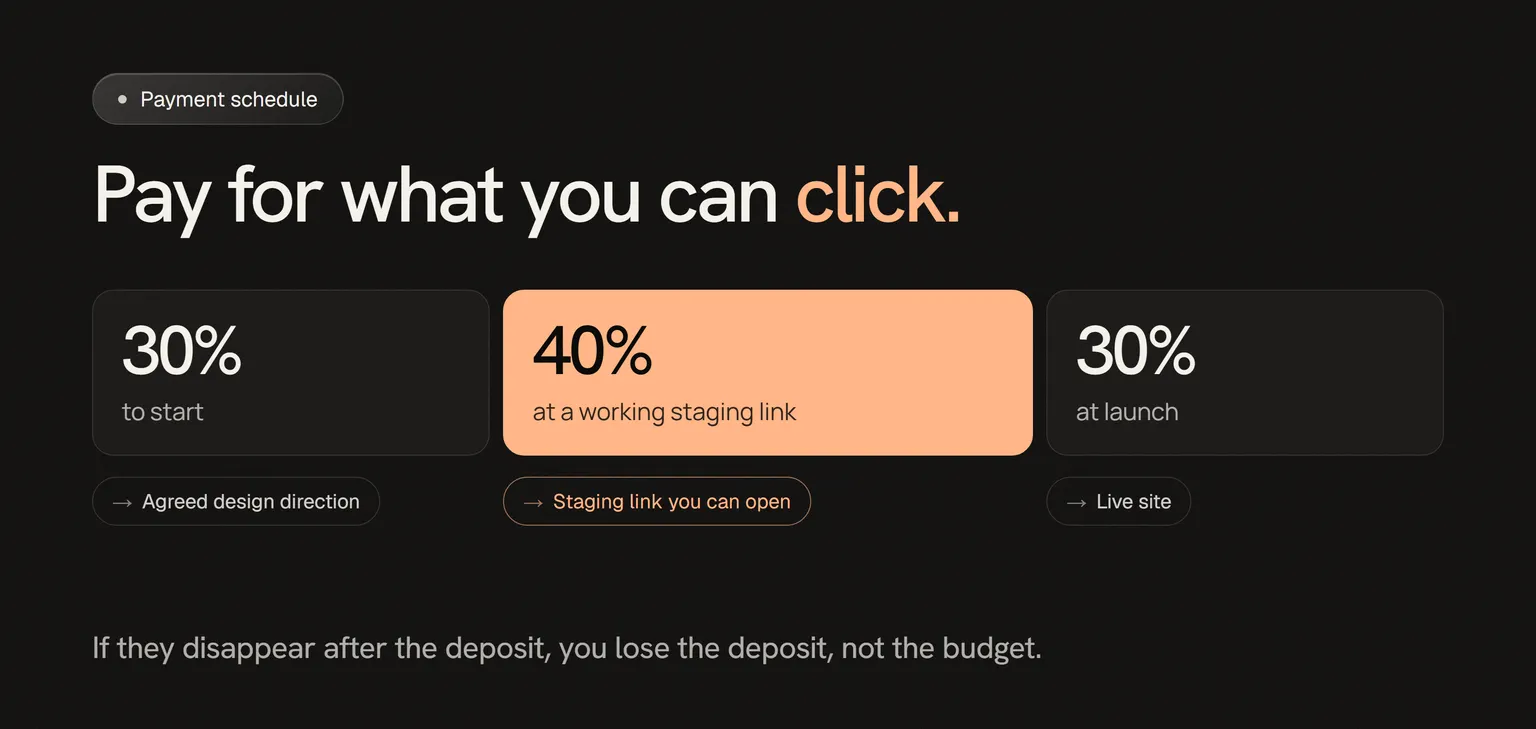
If most of the money is due before you have seen anything work, the risk is all yours. A fairer shape is a deposit to start, the next payment when a working staging link exists, and the last at launch. Each payment then buys you something you can open in a browser.
4. Check who owns the accounts
Whose hosting, whose domain registrar, whose Webflow or Framer workspace, whose admin login? The right answer is "yours, from day one." Otherwise you are renting access to a website, and whoever holds the logins holds you. Ask for documentation too: what the next developer would need to take over.
5. Test the reply time before you sign
Free, and the most honest test on the list. Email a real question on a normal working day and time the answer. Then ask what reply time they commit to during a project; one working day is a reasonable standard. Someone slow to reply while winning your work will not get faster once they have it.
6. Confirm they will stay invisible
No footer credit. No "built by" line in the code. No contact with your client unless you invite it. No portfolio posts without your written permission. A white-label builder should agree without a pause. One who hesitates wants the credit, and the credit is yours.
7. Fix the scope and the price before work starts
Get a written scope: pages, features, platform, revision rounds and what counts as extra. Then a fixed price against it. Hourly billing on an open scope is how website work leaks margin, and the overrun comes out of your pocket. A fixed scope also keeps things calm: when something new comes up, you both know it is new.
Which red flags should end the conversation early?
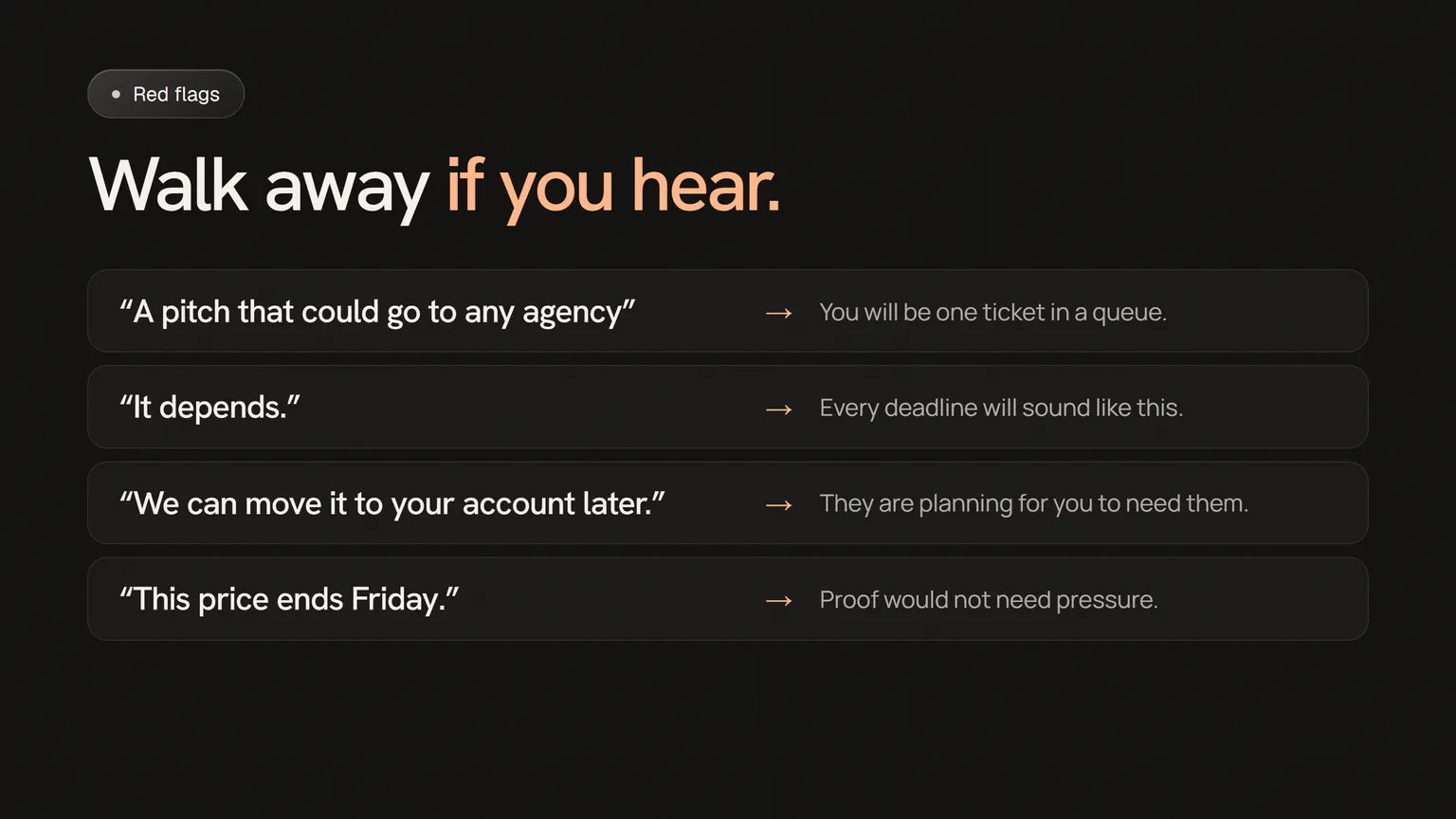
Some answers need no trial project. A generic pitch that could have gone to any agency means you will be one ticket in a queue. "It depends" with nothing after it tells you how every deadline conversation will go; a good builder says what it depends on, then commits to the part they control. Ownership that is "possible later" or costs extra means they are planning for you to need them. And a discount that expires on Friday is pressure, which proof would not need.
Start with one small, real project

Even after seven good answers, do not hand over your biggest client first. Give a new builder one real project with a short timeline: a campaign landing page, a small rebuild of a tired WordPress site, or your own agency website, the one you have meant to fix for a year.
A small project tests everything above in real conditions. Does the staging link arrive on the date? How do they handle feedback? Does the reply time hold when they are busy? If it goes badly, you lose a little on a low-stakes project. If it goes well, you have a builder you have watched deliver, the one thing a portfolio cannot show you.
What does this look like in practice?
I build white-label sites for agencies, so I hold myself to the same seven checks. I would be a hypocrite otherwise.
The habit started before I had agency clients. When I pitched for a law-directory project, I did not send a deck. I built a working demo, hosted it on a live link and sent it with the proposal. On the call, the client said it was smart. It was not really clever. It was proof before commitment: they could click the thing instead of imagining it.
That is now how I work with agencies. A working staging link within 3 working days of an agreed design direction, or your deposit back. If I am late, you choose: I finish the site, or we part ways. The clock starts when you confirm the design direction by email, and that confirmation states the actual date the staging link is due. Payments run 30% to start, 40% at the working staging link and 30% at launch. The site, logins and files sit in your own accounts from day one, fully documented. You get a fresh staging link every week and a reply from me within one working day. No footer credit, and no contact with your client unless you invite it.
None of that is special. It is the seven checks, written down as promises. You should expect the same from anyone you trust with your name.
Your next step
Before you sell the next website, send the first five checks to whoever builds for you now, or whoever you are thinking of trying. Ask for a working link. Ask what happens if they are late. Ask whose accounts the site will live in. Then time the reply.
If nobody on your list passes, start smaller: one builder, one real project, and a working staging link before the bulk of the money moves. Your name is on it. Somebody's deadline should be behind it.
Frequently Asked Questions
How long should it take a white-label developer to show a working staging link?
It depends on the scope, but for a small site you should see working pages within days of agreeing a design direction, not weeks. Ask for the date in writing and what happens if it is missed. If a builder will not commit to when you first see something working, treat that as your answer.
Should I pay a white-label web developer upfront?
A deposit is normal, but most of the money should follow things you can click. A schedule like 30% to start, 40% at a working staging link and 30% at launch keeps your risk small at every stage. When you vet a white-label web developer, look closely at how much is due before you have seen anything work.
What questions should I ask before hiring a white-label web developer?
Ask for a live working link, a written date for the first staging site, what happens if they are late, whose accounts the site will live in, what reply time they commit to and whether they will stay invisible to your client. Then ask for a fixed scope and price. The answers tell you more than a portfolio can.
How do I stop a white-label developer from holding my site hostage?
Insist that the site, domain, hosting and logins sit in your own accounts from day one, with documentation of how the site is built. Then, if the relationship ends, you lose nothing. A builder who wants to keep everything in their own accounts is a risk, whatever their portfolio looks like.
Is it safer to use a white-label agency or a freelancer?
Neither is safe by default. Shops can bury your project in a queue, and freelancers can disappear. The safer choice is whoever passes the checks: working links, payments tied to shipped work, your ownership of everything and a real consequence for being late. The best way to vet a white-label web developer of either kind is one small, real project.
