In-house or outsource? How small agencies should handle web development
Your website decides when your retainer starts. How small agencies should split web work between in-house and outsourced, and keep control of the date.

The client signs a twelve-month SEO and ads retainer. Everyone is happy. Then the work cannot start, because the new website is not ready, and the retainer that was meant to begin this month begins in two. Nobody planned for that gap. It is the most expensive part of running a small agency that nobody puts on the invoice. And it is the real reason the question of whether to keep web development in-house or outsource web development as a marketing agency matters so much.
Most advice on this compares salaries with freelance rates. That is the wrong maths. The thing that costs you is not the hourly price of a developer. It is the date. Whoever builds your sites decides when your retainers start. So the question to answer first is not "who is cheaper?" but "who controls the date, and how much can I see of it?"
Why the website decides when your retainer starts
For a marketing, SEO or ads agency, the website is rarely the main product. It is the gate in front of it. SEO needs pages to optimise. Ads need a landing page that converts. Social needs somewhere to send people. Until the site is live, all of that waits.
Many agencies sell the website cheaply, or include it free, to win the retainer. That makes sense on paper. In practice it means the least profitable piece of work controls the timing of the most profitable one. When the site runs late, you do not just lose time on the build. Your monthly income starts late, your team sits half-idle on that account, and you are the one explaining to the client why their campaign has not started.
So when you decide how to handle web development, you are really deciding how much you trust the gate.
What does in-house web development really cost a small agency?
Hiring a developer feels like the grown-up answer. You get control, a person in your team and no strangers involved. Here is what it actually brings with it.
Uneven work, steady salary. Website work at a small agency comes in waves. Three sites in one month, none the next. A senior developer is expensive in the busy months and idle in the quiet ones, and you pay for both.
Junior hires need checking. To keep costs down, many agencies hire junior. Then someone senior has to review the work, and that someone is often you. The owner's evenings become the quality control.
One developer is still one person. In-house does not remove the single point of failure. It moves it. When your one developer is sick, on holiday or leaves, the queue stops just as hard as when a freelancer goes quiet. Except now you also have a hiring process to run.
The stack keeps growing. WordPress, Webflow, Framer, hand-coded. Clients ask for different platforms, and one person rarely does all of them well. You either turn work away or ask your developer to learn on a client's project.
None of this makes hiring wrong. It means hiring is a bet on steady volume. If your website work is not steady, it is an expensive bet.
Why do marketing agencies outsource web development?
Most small agencies land in the same place: quick fixes stay in-house, full builds go out. Someone on the team can change a headline, swap an image or add a section. The full build, the rebuild and the urgent campaign landing page go to a white-label partner, because senior development talent is expensive to keep around between projects.
That split is sensible. The problems start with who the partner is. Offshore white-label shops have capacity, but your project can sit in a queue and quality depends on who picks it up that week. Solo freelancers give you direct contact, but agency owners lose sleep over the one who disappears halfway through. And templates or no-code platforms look like a shortcut until the price goes up or the template fights every change.
So outsourcing solves the cost of an idle salary and creates a new fear: losing control of the gate. That fear is fair. It is also fixable.
The reframe: rent the hours, keep the control

The in-house vs outsource question sounds like one decision. It is really two. Who does the building hours? And who holds the control: the client relationship, the accounts, the standard and the date?
You can rent the hours. You should never rent the control. An agency that outsources web development and keeps every account, every client conversation and a date it can check every week has more control than an agency with an in-house developer who keeps everything in their head.
Seen that way, the choice gets simpler. Keep the parts that make you the agency. Outsource the parts that are only labour.
What to keep in-house, and what to outsource
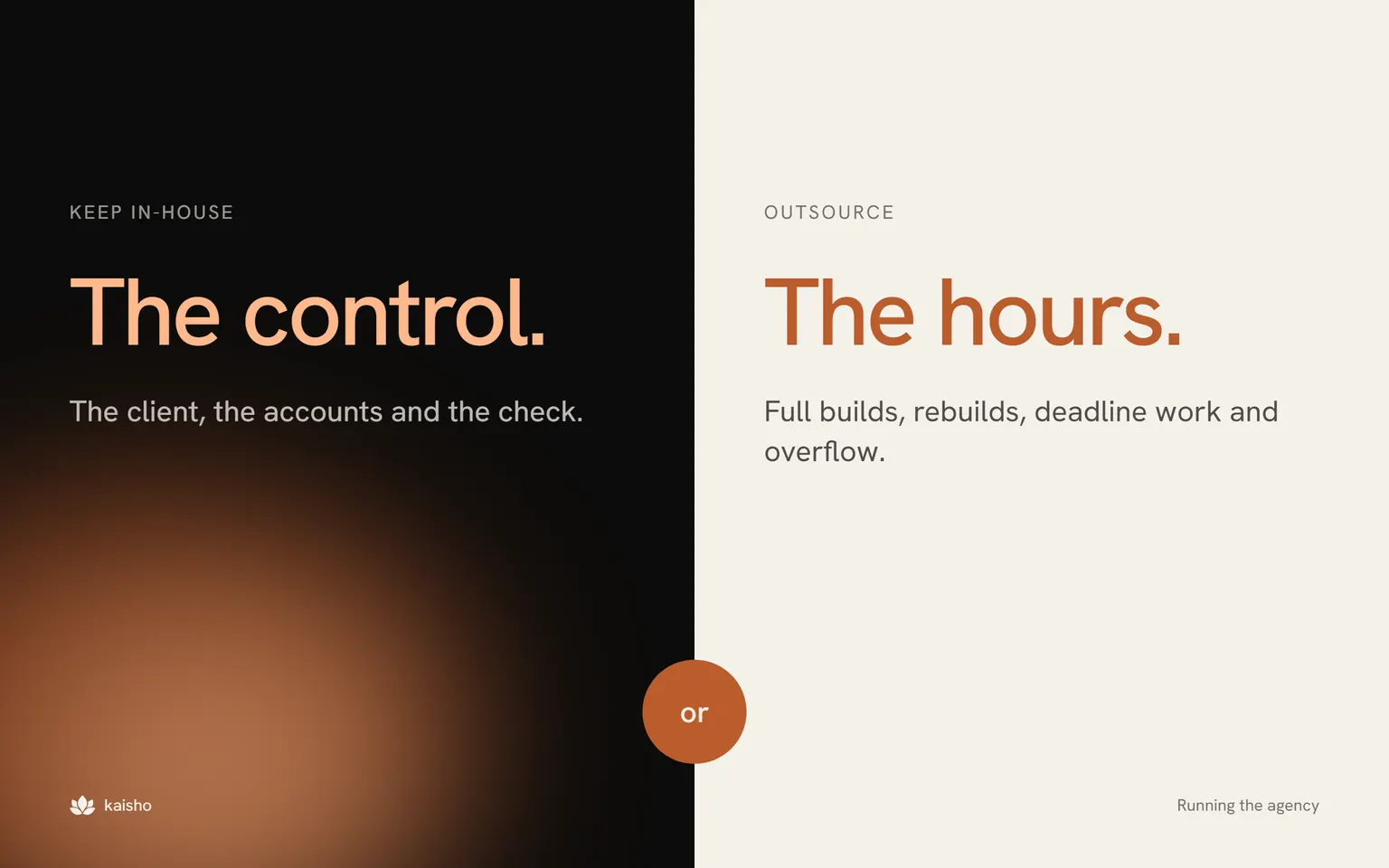
Keep in-house: the client. The relationship, the strategy and the brief are yours. Your partner should never contact your client unless you invite it, and should never need to. If your builder needs to talk to the client to understand the job, the brief was not finished.
Keep in-house: the accounts. Hosting, domain, CMS, the Webflow or Framer workspace. All in your name or your client's, from day one. This is the single most important thing you keep, because it is what lets you change partners without losing the site.
Keep in-house: the check. Someone on your team clicks through every staging link before it reaches the client. That takes minutes, not a developer. It also means you always know where the build really is.
Outsource: full builds and rebuilds. New client sites, especially the ones sold alongside a retainer, and the tired WordPress rebuild everyone has been avoiding. This is where senior skill matters most and is used least often.
Outsource: deadline work and overflow. The campaign landing page that has to be live next week. The busy month when three sites land at once. A partner absorbs the peak so you never hire for it.
Your choice: small edits. If someone on your team is comfortable in the CMS, keep them. If not, a monthly care arrangement with your builder covers edits, updates and fixes without anyone on payroll.
How to outsource web development without losing control
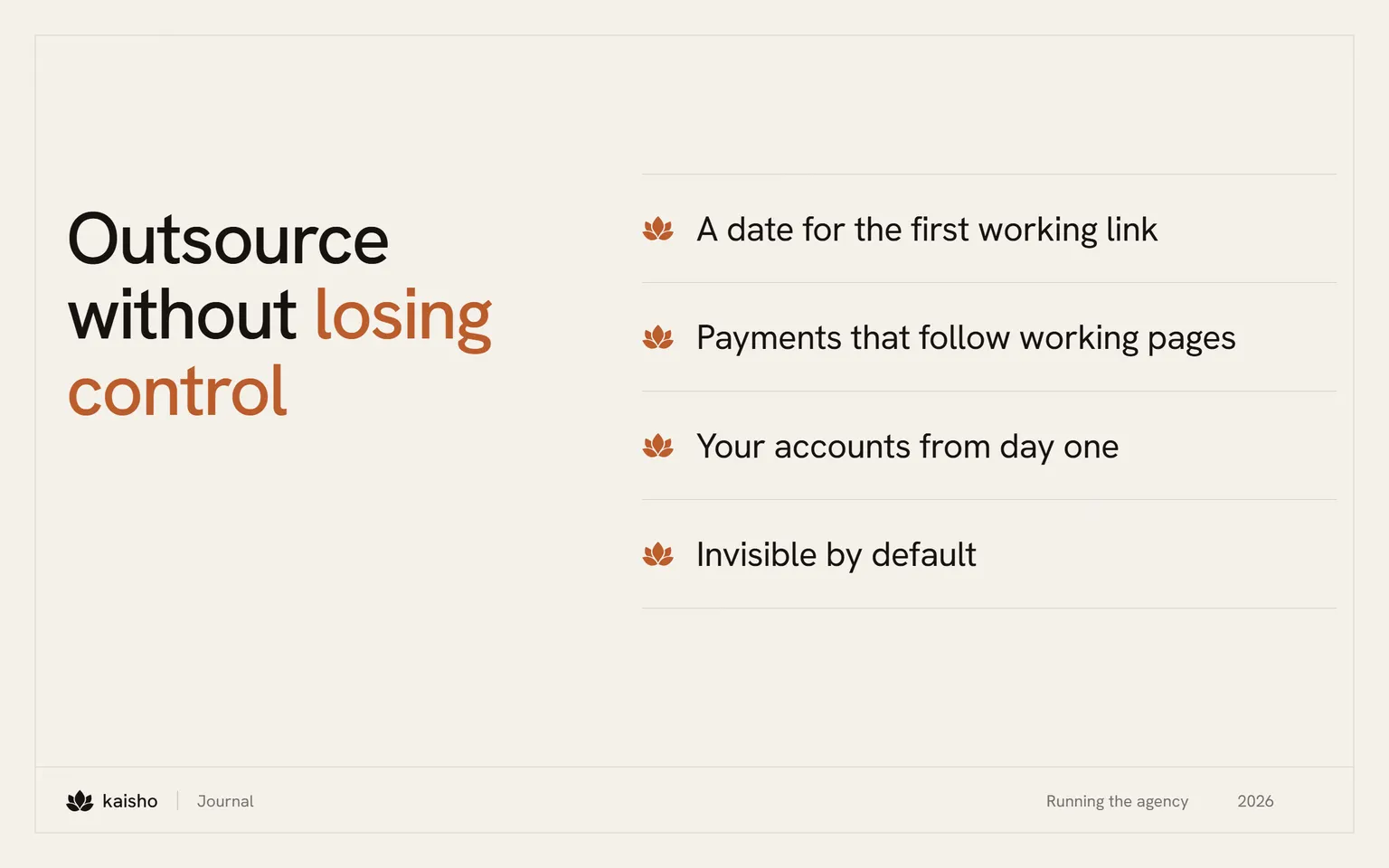
Four rules keep the gate in your hands, whoever does the building.
1. A date for the first working link. Not a launch date, which depends on how fast your client gives feedback. The date you will see working pages, counted from a clear start such as an agreed design direction. Then a fresh staging link every week.
2. Payments that follow working pages. A deposit to start, the next payment at a working staging link, the last at launch. Each payment buys something you can open in a browser.
3. Your accounts from day one. As above, with a short document on how the site is built, so another builder could take over.
4. Invisible by default. No footer credit, no client contact unless invited, no portfolio posts without your written permission. The credit is yours.
Before you pick anyone, run the checks in how to vet a white-label web developer before you sell the site. Then start with one small, real project before you trust them with your biggest client.
When does hiring a developer make sense?
Hire when the work is steady, not when it is stressful. If you have more website work than a good partner can take, every month, for months, and most of it is on the same platform, a full-time developer starts to pay for themselves. The same is true if websites have become a product you sell on their own, rather than the doorway to a retainer.
Until then, a reliable partner gives you the capacity of a dev team without the salary. Your clients see an agency that ships websites. They do not need to know who built them.
Where I fit
I build white-label websites for agencies, on WordPress, Webflow, Framer or hand-coded. I am the "outsource" option in this article, so here is what I hold myself to.
When I pitched for a law-directory project, I did not send a deck. I built a working demo, put it on a live link and sent it with the proposal. On the call, the client said it was smart. It was really just proof before commitment, and it is still how I work.
A working staging link within 3 working days of an agreed design direction, or your deposit back. If I am late, you choose: I finish the site, or we part ways. The clock starts when you confirm the design direction by email, and that email states the actual date the staging link is due. Payments run 30% to start, 40% at the working staging link and 30% at launch. The site, logins and files are in your accounts from day one, fully documented. A fresh staging link every week, a reply from me within one working day, no footer credit and no contact with your client unless you invite it.
That is the gate, kept in your hands.
Your next step
Look at the last three websites you sold. For each one, write down how many weeks passed between the signed retainer and the day the retainer work could actually start. That number is what your current setup costs you.
If it is bigger than you would like, do not hire yet. Pick one upcoming site, outsource just that one with the four rules above, and compare the gap. Your name is on the website. Make sure you can see the date behind it.
Frequently Asked Questions
Should a small marketing agency hire a web developer or outsource?
Outsource until your website work is steady every month on one main platform. Below that, a salaried developer spends quiet months idle and busy months overloaded. Most small agencies keep small edits in-house and outsource full builds, rebuilds and deadline work.
Is it safe to outsource web development as a marketing agency?
It is safe when you keep the control: the client relationship, every account and a date you can check each week. When you outsource web development as a marketing agency, tie payments to working staging links and keep the hosting and domain in your own name. Then a bad partner costs you a deposit, not a client.
What web work should an agency keep in-house?
Keep the client relationship, the brief, the accounts and a quick check of every staging link before the client sees it. Small edits can stay in-house if someone on the team is comfortable in the CMS. Full builds and urgent landing pages are usually better outsourced.
How do I stop an outsourced website from delaying my retainer?
Get a written date for the first working staging link, then a fresh link every week, so a delay shows up in days instead of at the deadline. Tie payments to those links. That keeps the website, the gate in front of your retainer, somewhere you can see it.
Will my client know I outsource web development?
Not if you set it up properly. A white-label partner adds no footer credit, never contacts your client unless you invite it and never shows the work without your written permission. Your client sees your agency delivering their website.
