How to price websites so they stop leaking margin
Websites take agencies the most effort and often earn the least. Where the margin leaks, and a six-step way to price websites as a product, not a favour.

You priced the website low to win the retainer. It made sense in the meeting. Then the client asked for one more page, then a booking form, then a second round of changes on the homepage. Your builder billed the extra hours. You spent your evenings in the feedback thread. Six weeks later the site launched, and when you finally added it up, the website had cost you money. That is the quiet problem with agency website pricing: the work that takes the most effort often earns the least.
One agency owner on Reddit put it bluntly: "Unpriced work is the most common margin leak in agencies, more than scope creep even." Websites are where that leak is biggest, because they are so often sold as a side line inside a marketing package. This article is about closing it. I build websites for agencies, so I see the other side of these quotes.
Why do websites leak margin at agencies?
Most agencies are very good at pricing what they know: SEO, ads, social, strategy. They price those by the month and they know exactly what a month of work looks like. Websites are different. They come in irregular shapes, they depend on someone else's build time and they are often treated as the thing you give away to win the real contract.
So a website gets priced in one of three ways. As a favour, to land the retainer. As a guess, based on what the last one cost. Or as a pass-through, the builder's quote plus a little on top. All three skip the same thing: what the website actually costs you to deliver, including your own time.
Where does the margin actually go?
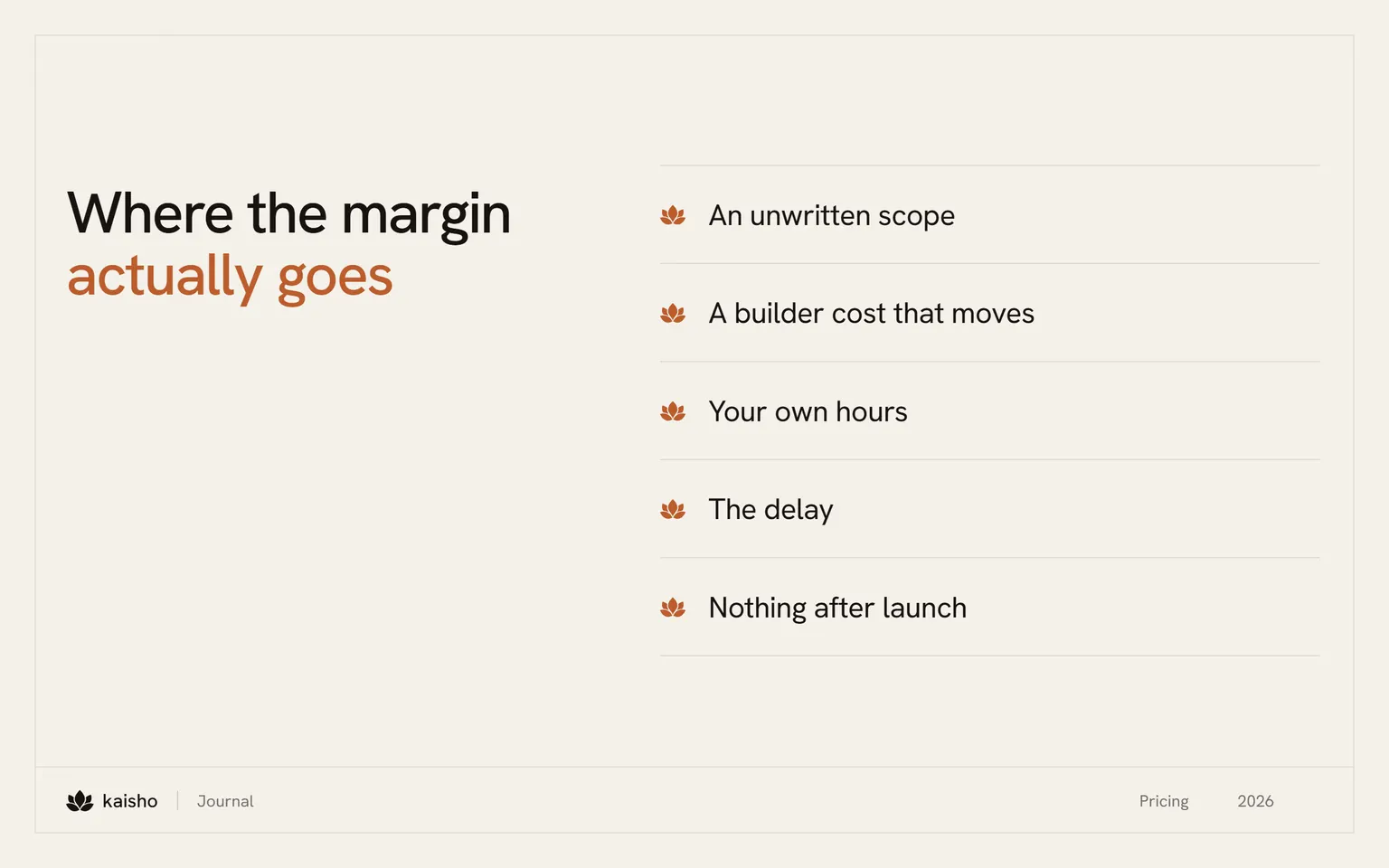
An unwritten scope. "A five-page website" is not a scope. Which five pages? Is there a blog? A booking form? How many languages? When the scope lives in an email thread, every new request feels like part of the original deal, and your client is not wrong to think so.
A builder cost that moves. If your developer bills by the hour, every change your client asks for comes out of your margin. You fixed the price to the client, but not your own cost. That gap is where most website profit disappears.
Your own hours. The brief, the calls, collecting content, passing feedback back and forth, checking the build before the client sees it. Agencies rarely count this time, because nobody sends an invoice for it. It is still the most expensive time in the building: yours.
The delay. A late website is a pricing problem too. If the retainer cannot start until the site is live, every week of delay is a week of retainer income that did not arrive. That cost never appears on the website quote, but you pay it.
Nothing after launch. The site goes live, the client asks for small edits for the next year, and someone on your team does them for free because it feels awkward to charge. A website with no plan after launch keeps costing long after it stopped earning.
The reframe: price the website as a product, not a favour
The fix is not a higher number. It is treating the website as a product with a defined shape, a known cost and a margin you decide in advance. Products have specs. Products have a price list for extras. Products come with something after the sale.
When you price that way, two things change. You can say yes to every website request without dread, because you know each one makes money. And your client gets a clearer deal: they know what they are buying, what costs extra and when they will see it working.
How should an agency price a website?
Work through these in order. Each step closes one of the leaks above.

1. Write the scope before the number
List the pages, the platform, the features and the integrations. Say who supplies the copy and images. Say how changes work: as many as needed within the agreed scope, with anything outside it priced separately. A one-page scope takes an hour to write and saves you weeks of arguing about what was included.
2. Fix your build cost
Ask your builder for a fixed price against that written scope, not an hourly estimate. If they will not fix it, the risk of every overrun is yours. A fixed build cost is the single biggest step towards predictable agency website pricing, because it turns the most uncertain number in your quote into a known one.
3. Count your own time honestly
Estimate the hours you and your team will spend on the brief, client calls, content, feedback and checking. Multiply by what that time is worth to you, not by zero. If the number surprises you, that is the margin you have been giving away.
4. Decide the margin first, then the price
Build cost plus your time is your real cost. Add the margin you want on top, then check the result against what the website is worth to the client. If the price feels too high to sell, reduce the scope, not the margin. A smaller site that makes money beats a bigger one that does not.
5. Bill in milestones that match your builder's
If you pay your builder in stages, bill your client in the same stages: a deposit to start, a payment when there is a working staging link and the rest at launch. Your cash never goes negative, and every invoice your client pays matches something they have seen working.
6. Price what happens after launch
Offer a monthly care plan for updates, backups, fixes and small edits. It turns the website from a one-off project into recurring income, and it stops the free edits that quietly eat the next year. Many agencies already think in retainers. This is a small one.
Should you include the website free to win a retainer?

Sometimes it is a smart move. A site that wins you a year of SEO work can be worth giving at cost. But do it on purpose, not by accident. Write the scope anyway. Know the real cost. Tell the client the website's actual value, so they know what they are getting, and cap the changes clearly. A free website with no scope is the most expensive thing an agency sells.
And make sure the build cannot run late, because a free website that also delays the retainer costs you twice. Before you hand it to anyone, run the checks in how to vet a white-label web developer before you sell the site.
How do you handle change requests without losing the client?
Agree what "extra" means before the work starts, in writing, and keep a short list of common extras with a price next to each: an extra page, a new form, a second language. When a request comes in, you are not negotiating. You are pointing at the list.
Most clients are fine with this. What upsets them is surprise. A clear price for an extra page is a normal conversation. A bill for "additional hours" at the end of the project is not.
What this looks like when I build for an agency
I publish from prices, because fixed costs are what make your pricing work. A First Project, one landing page, starts from €690. A Client Build starts from €1,490 on WordPress or hand-coded, or €1,790 on Framer or Webflow. Custom work starts with a €690 Scoping Sprint that gives you a written scope and a fixed price, credited in full if you go ahead. All excluding VAT. After launch, care plans run per site per month: Care at €150, Care Plus at €290 and Growth at €590. You can resell any of these under your own name.
The fixed price sits on a written scope, and the timing is fixed too. A working staging link within 3 working days of an agreed design direction, or your deposit back. If I am late, you choose: I finish the site, or we part ways. Payments run 30% to start, 40% at the working staging link and 30% at launch, so you can bill your client in exactly the same stages. The site, logins and files live in your accounts from day one, with a reply from me within one working day and no contact with your client unless you invite it.
The habit of proof came first. When I pitched for a law-directory project, I built a working demo and sent the live link with my proposal instead of a deck. The client said it was smart. It was just a way to show the thing before anyone paid for it.
Your next step
Take the last website you sold. Write down what you charged, what the build cost you and roughly how many hours you and your team spent on it. Then do the sum. If the margin is thinner than you thought, you have found your leak.
Then price the next one the other way round: scope first, fixed build cost, your own time counted, margin decided before the number. Your name is on the website. It should make you money.
Frequently Asked Questions
How much should an agency charge for a website?
Start from your real cost, not from a competitor's price: a fixed build cost plus the hours you and your team spend, then the margin you decide in advance. Good agency website pricing comes from a written scope, so the price matches a clear list of pages and features. If the result is too high for the client, shrink the scope rather than your margin.
Should agencies charge hourly or a fixed price for websites?
A fixed price on a written scope is usually safer for both sides. Your client knows what they will pay, and you know what you will earn, as long as your builder's cost is fixed too. Hourly pricing moves the risk of every change onto whoever fixed their price first.
How do I stop scope creep on website projects?
Write the scope before you agree the price and define what counts as extra. Keep a short price list for common extras, such as an extra page or form, so change requests become a simple choice instead of a negotiation. Most scope creep comes from scope that was never written down.
How much margin should an agency make on a website?
There is no single right number, but it should be a number you decide before quoting, not whatever is left at the end. Count your own team's hours in the cost, because they are the part most agencies forget. If a website does not make margin, reduce the scope or rethink giving it away.
Should I add a care plan when I sell a website?
Yes, in most cases. A monthly care plan covers updates, backups, fixes and small edits, and turns a one-off project into recurring income. It also stops the free edits that slowly eat the margin you made on the build, and it is an easy add-on for agency website pricing you already sell by the month.
